 Beyond the Scroll
Replacing Passive Scrolling with Active, Intentional Interactions
Swiping and scrolling have become some of the first screen gestures children see. They watch adults move through messages, photos, videos and feeds with a flick of a finger, so it is natural that they want to copy it. Children learn by imitation. The question is not whether they will encounter screens, but what kind of screen habit they will have the chance to practise. Can a screen simply deliver more content, or can it invite your child to notice, choose, try and respond?For children aged one to five, that distinction matters. At this stage, small repeated actions help shape both their physical skills and their expectations of the world.A screen can be something that happens to them, or it can be a place where their own actions have a clear purpose.
The difference between watching and doing
Passive screen experiences ask very little of a young child. A video plays, another one begins automatically, or a stream of images continues as they swipe. There may be bright colours, songs and familiar characters, but the child does not need to make a meaningful decision for the experience to continue. Their main job is to keep watching, or to swipe again for something new.There is nothing wrong with enjoying a short video together or using a screen for a quiet moment. But passive content is designed to hold attention, not necessarily to build a skill. When the next image, clip or game appears without effort, the habit being rehearsed is simple: keep moving on until something catches your eye.
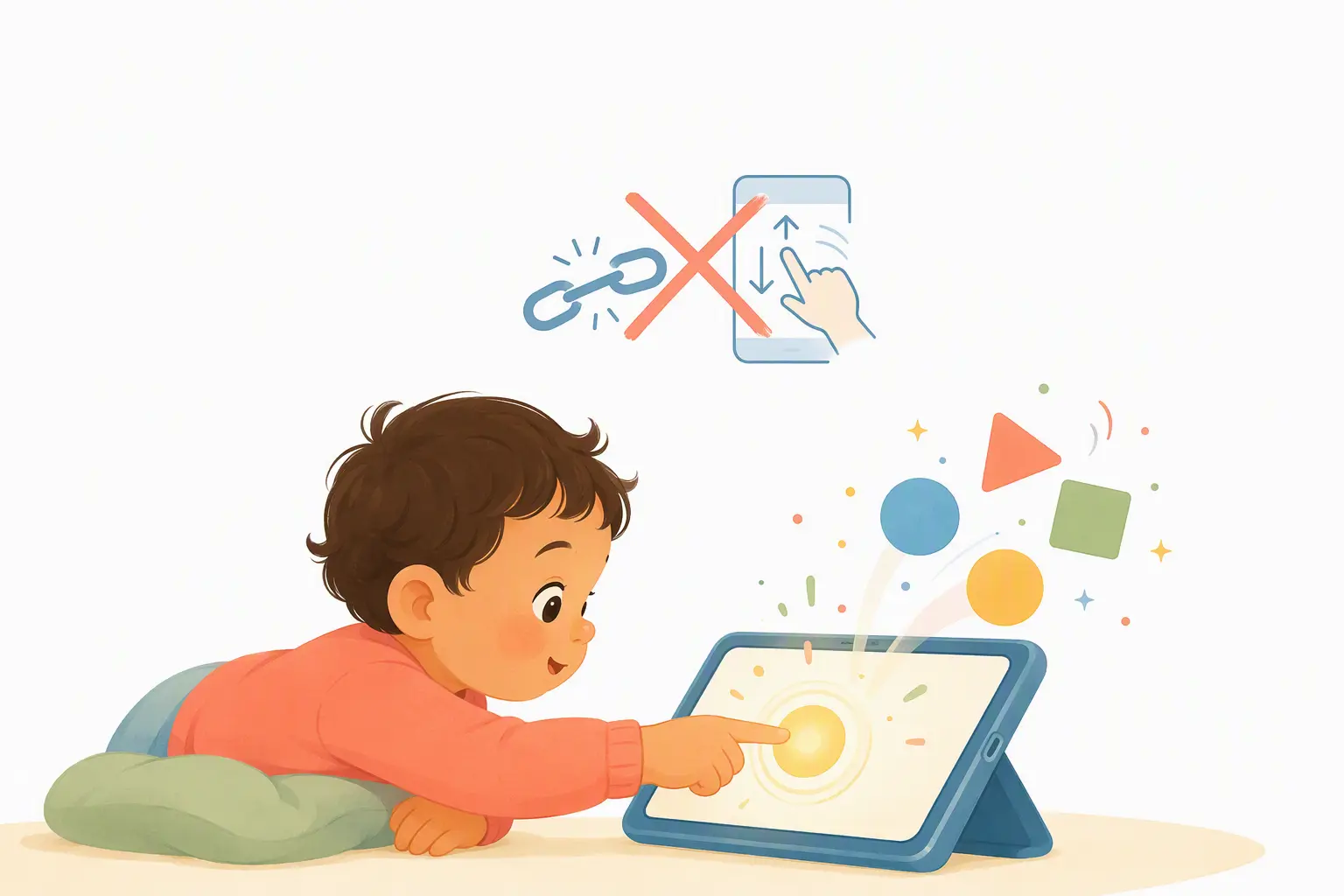
Active interaction is different. It gives your child a small, understandable task. They might touch an animal to hear its name, drag a circle into the matching outline, select the red object when asked, or choose which item belongs in a group. The screen responds to what they do, rather than carrying them along.
That response creates an important connection: "I did something, and something happened because of it." Dragging supports hand and finger control. Matching asks a child to compare shapes, colours or sizes. Selecting an answer encourages attention, memory and early decision-making. Even when the task is simple, your child is practising the relationship between noticing, acting and seeing a result.
Purposeful interaction turns screen time into practice for the skills your child is already developing - noticing, choosing, and trying again.
What intentional interaction looks like
Intentional learning does not need to be complicated to be meaningful. For very young children, the best activities are often clear, focused and easy to repeat. They give a child enough challenge to feel involved without creating frustration.- A toddler drags a shape towards its matching space and sees it settle into place.
- A child taps the correct colour after hearing a simple prompt such as, “Can you find blue?”
- A preschooler chooses the larger of two objects and receives immediate, calm feedback.
- A child touches different pictures to hear names, sounds or facts, then returns to the ones that interest them most.
These moments can look small from the outside. Yet they involve several skills at once. Your child is paying attention to the instruction or image, deciding what to do, coordinating their hand movement and noticing the outcome. If they try again after an incorrect choice, they are also learning that mistakes are part of working something out.
For children between one and five, repetition is not a sign that an activity lacks value. Repetition is often how learning settles in. A child who returns to the same matching activity may be strengthening hand control, becoming more confident with a concept, or enjoying the satisfaction of knowing what to do next.
The habit you’re building matters
Children are always learning what to expect from the things around them. Repeated screen experiences quietly teach them a pattern of behaviour. If most of those experiences involve endless feeds, automatic videos or games that do not require much thought, a child may begin to see screens mainly as something to consume.That does not mean a child who watches videos has done anything wrong, or that parents must remove every passive experience. Families have busy days, long journeys, illnesses and moments when a familiar show is useful. The aim is not perfection. It is to recognise that the kind of interaction your child practises most often can influence how they approach digital spaces.
When an app regularly asks your child to participate, it offers a different pattern. Your child learns to wait for a prompt, make a choice, test an idea and see what follows. They begin to expect that their input matters. This is an early foundation for problem-solving: not having the answer immediately, but trying something and learning from the result.
It can also support confidence. A young child who completes a small task independently experiences genuine success. They placed the shape. They found the colour. They made the choice. That sense of agency is more valuable than simply reaching the next clip.
How to spot active versus passive apps
You do not need to analyse every app in detail. A few straightforward questions can help you decide whether an experience is inviting your child to take part or simply encouraging them to keep watching.
- Does my child have to do something meaningful, or is content mostly playing on its own?
- Is there a clear action and result?
- Does the app respond to what my child chooses? A good activity acknowledges correct choices, gives gentle opportunities to try again and lets the child influence what happens.
- Is the task appropriate for my child’s stage? For younger toddlers, simple touching, naming and matching work well. Older preschoolers may enjoy sorting, sequencing and solving slightly more involved problems.
- Can my child pause, repeat or explore without being rushed?
It can help to sit with your child for the first few minutes. Notice whether they are pointing, answering, trying and talking, or whether they are mostly waiting for the screen to entertain them. Their behaviour will often tell you more than an app description can..
A small shift that compounds
You do not need to eliminate all passive screen time to make thoughtful choices for your child. Sometimes watching something together is enjoyable, comforting or simply practical. What matters is creating balance and choosing interactive experiences often enough that your child practises being an active participant, not only a viewer.
When you next choose an app, look for one that asks your child to touch with purpose, make a choice and discover what happens next. That small shift-from scrolling for more to interacting with intention-can help turn screen time into practice for the skills your child is already beginning to build every day.
Related articles:
https://www.commonsensemedia.org/2016/experts-explain-the-value-of-co-viewing-for-young-children
https://www.nuffieldfoundation.org/nurture-not-neglect-digital-devices-and-early-years