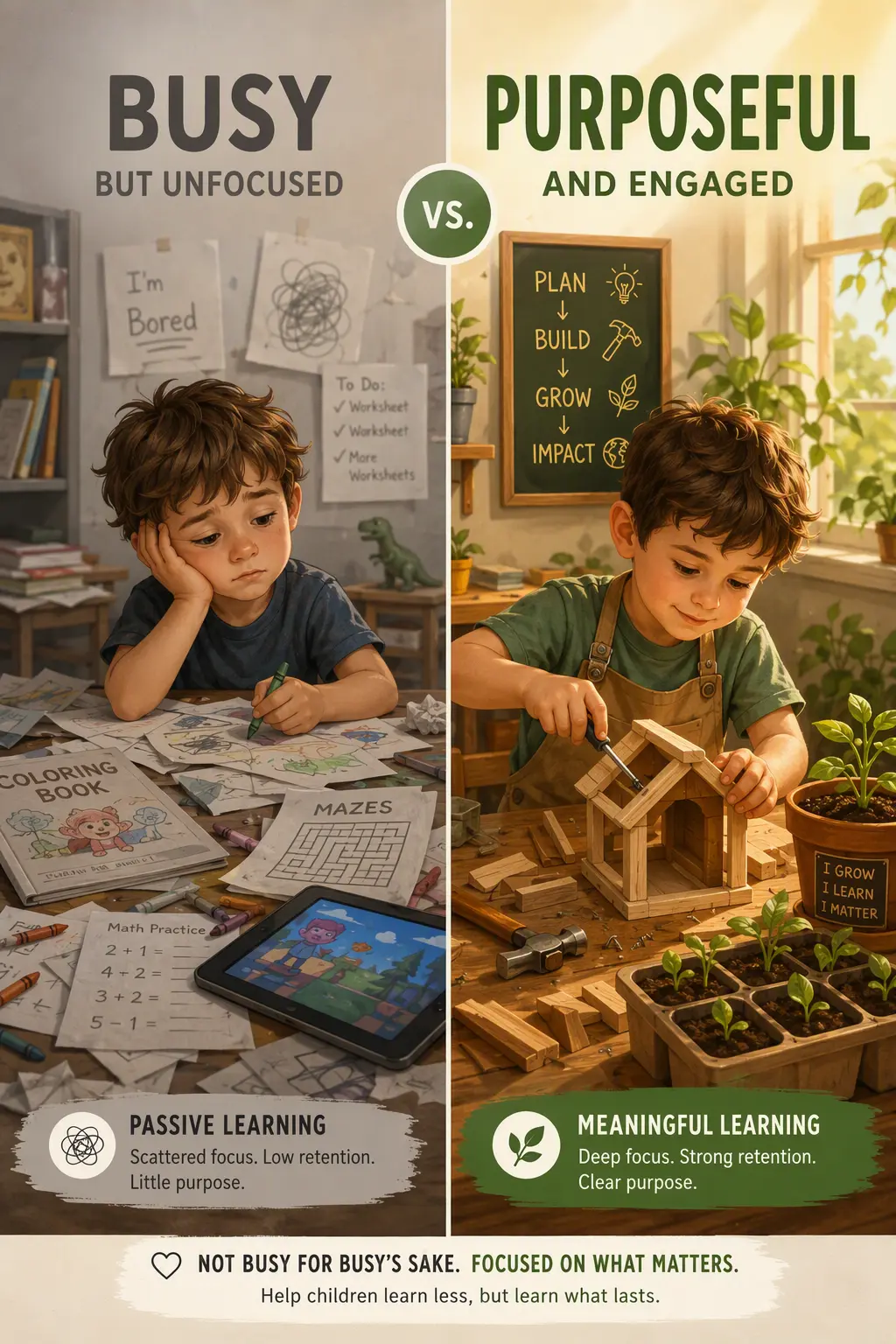
Children do not need every minute packed with noise, worksheets, videos, and reminders to “stay on task.” They need opportunities to do something that matters to them. This is the difference between being busy and being occupied: busy fills the clock; occupied gives a child a reason to use their mind, hands, and attention.
When “busy” becomes the goal
Modern childhood is full of efforts to prevent empty time. A child fidgets in line, so they are handed a screen. A class finishes early, so they receive another worksheet. An afternoon feels too quiet, so an adult adds a scheduled activity. Sometimes these choices are practical. But when keeping children occupied simply means keeping them quiet, compliant, or out of the way, we are aiming far too low.
A full schedule can still leave a child bored, disconnected, and hungry for something real to do. The same goes for a game that rewards endless tapping without challenge, or a craft with every step prescribed so tightly that every finished project looks identical.
Children can sense the difference. They know when an activity exists only to use up twenty minutes. They may complete it, but completion is not the same as engagement.
Occupation needs a purpose
Being truly occupied means being engaged in an activity with intent. The child understands, at least in a simple way, what they are doing and why. They have room to make choices. The activity asks for attention, and that attention leads somewhere: a skill grows, a question gets answered, a problem gets solved, or an idea takes shape.
Purpose does not have to mean serious or solemn. Play can be deeply purposeful. Building a tower, making up a story about an emu, sorting leaves by shape, or trying to beat yesterday’s puzzle score can all have meaning. The point is not whether the activity looks educational from across the room. The point is whether the learner is invested in it.
- Intent: There is a reason to begin, such as discovering how something works or making something new.
- Agency: The learner gets meaningful choices, not just instructions to follow.
- Challenge: The task is interesting enough to require thought without becoming discouraging.
- Satisfaction: The reward is not only finishing; it is the pleasure of figuring out, creating, improving, or sharing.
When all four are present an activity stops being something done to a child and becomes something the child owns. That is occupation with substance. It respects a child as a person with a mind, not as a problem waiting to be managed.
Purposeful versus pointless: the difference in practice
The contrast often appears in small everyday moments. Consider a child waiting at a restaurant. A pointless occupation might be autoplay videos selected only to keep the table quiet. A puzzle book that asks them to spot patterns or solve a riddle. Both may provide a few minutes of calm. Only one gives those minutes a direction.
Or consider math practice. A page of twenty identical addition problems can become a race to finish, with little thought beyond getting through it. A purposeful alternative might ask a child to use ten counters to create as many number pairs as possible, record their discoveries, and explain which combinations they found. The underlying skill is similar. The experience is not. One treats practice as a hurdle; the other turns it into investigation.
Even screen time can make the distinction clear. Passive scrolling is designed to hold attention, not necessarily to earn it. A well-designed educational activity gives the learner something to do with their attention. They listen, identify, compare, try again, and see the result of their choices. The device is not acting as a babysitter. It is a tool for active learning.
The Occupy Educate difference
At Occupy Educate, occupation is not a polite word for distraction. We believe time is worth more than being filled. Whether a child has five minutes in a waiting room or a quieter hour at home, that time can become a moment of curiosity, confidence, and genuine accomplishment.
Purpose changes the feeling of an activity. A child who is merely busy watches the clock, asks when they are done, or moves from one prompt to the next without connection. A child who is occupied in the fullest sense is invested. They want to see what happens. They try a different answer. They take pride in learning something they did not know a few minutes earlier.
Adults deserve this kind of engagement too. We all know the difference between work that drains time and work that asks something meaningful of us. Children deserve the same respect for their attention. They do not need more things to do. They need better reasons to do them.
So the next time you need an activity, ask one simple question: will this only keep them busy, or will it give their time meaning? Choose the second whenever you can. That is how we stop wasting their time and start respecting it.
Find apps that can both Occupy and Educate your child in our store at OccupyEducate.com