by Eddy The Emu

Why Offline Learning Matters When Building a Safer Digital Routine for Ages 2-4


A child using a tablet outside in a topiary garden. The art style is soft atmospheric watercolors.

For families with children ages 2-4, a safer digital routine starts with choosing experiences that do not depend on the open internet. BrightSHAPES and Eddie the Educated Emu are built around a simple mission: give young children playful educational activities that work offline, without ads, external links, or the constant pull of online content. That means parents can offer a short learning moment with greater confidence and fewer interruptions.

Young children do not need an open internet to learn

Toddlers and preschoolers learn through repetition, curiosity, language, movement, and responsive play. They do not need autoplay queues, recommended videos, notifications, or a stream of new content to practice these skills. In fact, a focused activity can be more useful when it has a clear beginning and end.

An offline educational app keeps the experience centered on the activity in front of the child. When a child is matching shapes, listening for a word, identifying a color, or following Eddie the Educated Emu through a playful prompt, the learning goal is not competing with a new thumbnail or an attention-grabbing advertisement.

  • There are no outside recommendations leading children away from the activity.
  • There is no need to hand over a device connected to a browser or video feed.
  • Activities can be used during travel, appointments, or quiet time without relying on Wi-Fi.
  • Parents can create a familiar routine around a small, purposeful selection of play.

Offline design removes common sources of distraction

Many digital products are designed to keep people clicking, scrolling, and returning. That model is especially mismatched with the needs of very young children, who benefit from adults setting clear limits and from activities that do not turn every pause into another invitation to keep watching.

BrightSHAPES takes a different direction. Its educational fun is designed as a destination rather than a doorway to an endless feed. Eddie the Educated Emu provides a friendly, recognizable guide, while the app experience stays focused on age-appropriate discovery. Without advertisements loading between activities or online material appearing unexpectedly, adults can spend less time intervening and more time sharing the moment.

This does not mean that every screen moment must be long or highly structured. A five-minute activity while dinner is being prepared, a calm game in a waiting room, or a familiar learning session before a nap can all fit into a thoughtful family routine. The important part is that the technology supports the routine instead of trying to take it over.

A familiar character can make learning feel approachable

Children ages 2-4 are still learning how to approach new tasks. A warm, consistent character can help make an educational activity feel less like a test and more like an invitation to play. Eddie the Educated Emu gives children a recognizable companion as they encounter early concepts.

Consistency matters at this age. When the app presents activities in a familiar, uncluttered setting, children can direct more energy toward the learning task itself. They may begin to recognize what comes next, try again after a mistake, or name what they see aloud. Those small moments build confidence because the environment feels understandable.

Parents can extend that familiarity beyond the screen with simple conversation. Ask, “Which shape did you find?” or “Can you show me something at home that is the same color?” A brief question turns a digital activity into a bridge to real-world observation, language, and shared play.

Ad-free learning supports adult choice

An ad-free experience is not only about avoiding unsuitable promotions. It also protects the parent’s role in deciding what a child sees and when. Advertising often introduces unfamiliar products, characters, sounds, and requests at moments when a child is focused on something else. For a young child, that interruption can be confusing; for an adult, it can create an unnecessary negotiation.

With BrightSHAPES, the activity remains the activity. There is no sales message asking for attention and no commercial content positioned beside early learning. This allows caregivers to make intentional choices about screen use based on the child’s needs, not on prompts built into the product.

  1. Choose one activity before opening the app.
  2. Stay nearby when possible, especially when introducing something new.
  3. Use simple words to describe what the child is doing: sorting, finding, listening, matching, or counting.
  4. End with a transition to an offline activity, such as drawing a shape, finding colors in a room, or reading a book together.

Safe edutainment should fit into everyday family life

A protected digital experience is most valuable when it works in ordinary moments. Families need options for a rainy afternoon, a quiet car ride, a restaurant wait, or the few minutes when a caregiver needs to finish a task nearby. Offline edutainment can offer that support without asking children to navigate a busy online environment.

BrightSHAPES is created for those real-life moments. Its mission is not to replace hands-on play, conversation, outdoor time, books, or caregiver connection. It is to provide a safer, educational option when a device is part of the day. Eddie the Educated Emu helps make that option playful, familiar, and focused for young learners.

Start by choosing one short BrightSHAPES session to pair with a daily routine this week. Sit with your child when you can, name what they are discovering, and follow the activity with a simple real-world game. Small, intentional choices can help make digital learning feel safer and more useful from the very beginning.

by Eddy The Emu

A Calm Learning Companion for Toddlers: OccupyEducate.com’s Ad-Free Mission


For children ages 2-4, a good learning app should feel like a welcoming activity, not a noisy marketplace. OccupyEducate.com is built around that belief: offering ad-free edu-tainment through offline-friendly experiences with Eddie the Educated Emu. Families get a simple way to add playful learning to a daily routine without handing toddlers an app full of interruptions, promotions, or confusing detours.

Early Learners Need Clear, Simple Experiences

Toddlers are learning how to focus, follow directions, name what they see, and keep trying when something is new. Their attention is still developing, so the design of a digital activity matters as much as the educational idea behind it. A crowded screen, a sudden pop-up, or a button that leads away from the activity can quickly turn curiosity into frustration.

OccupyEducate.com centers its approach on age-appropriate, single-purpose edutainment. Eddie the Educated Emu helps make learning feel friendly and approachable while activities stay focused on the task in front of the child. Instead of asking a young learner to sort through endless choices, the experience can support a straightforward pattern: see, listen, touch, respond, and try again.

Ad-Free Means the Activity Stays About the Child

Advertising is designed to compete for attention. For adults, that can be annoying; for a two-, three-, or four-year-old, it can be especially distracting. An ad may use bright colors, animated movement, unfamiliar characters, or a tempting prompt to tap. Even when a child cannot read the words, the interruption can pull them away from the learning moment.

An ad-free environment keeps the purpose clear. Children can spend their time matching, identifying, listening, and exploring rather than encountering material that has nothing to do with the activity. Parents and caregivers do not have to repeatedly step in to close promotions or explain why a new screen appeared.

  • No marketing messages competing with educational content
  • No accidental taps leading away from an activity
  • No pressure to make a purchase in the middle of play
  • No need to explain adult-oriented advertising to a toddler

This is not merely a cleaner-looking screen. It is a more consistent experience in which the child’s attention remains with the learning activity and the character guiding it.

Offline Play Helps Learning Fit Real Family Life

Young children do not only learn in ideal conditions at home. Families need options during a car ride, while waiting for an appointment, on a flight, or in a location with unreliable internet. Offline educational play gives caregivers a dependable activity without searching for a connection or worrying about what may load next.

Offline access also supports a more intentional handoff. A caregiver can open an Eddie the Educated Emu activity, offer the device for a short period, and know that the experience is designed to remain centered on the app. There is no need to browse for a video, follow recommendations, or navigate a stream of unrelated content.

For example, a parent might use a brief activity after breakfast, during a quiet transition before leaving the house, or while preparing dinner. The goal is not to fill every minute with a screen. It is to have a calm, purposeful option available when a short learning activity genuinely helps.

Edu-Tainment Works Best When Play Has a Purpose

For ages 2-4, learning often happens through repetition, sound, movement, and positive encouragement. A child may need to hear a word many times before using it confidently or repeat a matching task before recognizing the pattern independently. Playful design makes that repetition feel rewarding rather than like a test.

Eddie the Educated Emu brings personality to the experience without turning learning into a race for points or prizes. The emphasis is on inviting children to participate. When a child names an object, recognizes a shape, responds to a sound, or completes a simple task, they are practicing early skills in a format suited to their stage of development.

  1. Choose a short activity that matches the child’s energy level.
  2. Stay nearby, especially when introducing something new.
  3. Use simple prompts such as “What do you see?” or “Can you find the matching one?”
  4. Celebrate effort as well as correct answers.
  5. End while the child is still engaged, then move on to an off-screen activity.

These small interactions help connect digital play with real-world conversation. A shape on screen can lead to finding the same shape in a room. A word heard in an activity can become part of a story, a snack-time chat, or a walk outside.

A Thoughtful Alternative to Endless Digital Noise

OccupyEducate.com’s mission is rooted in a practical idea: little learners deserve digital experiences made with their needs in mind. That means keeping the environment ad-free, supporting offline use, and creating educational fun that does not rely on clutter or constant stimulation to hold attention.

Caregivers remain the most important part of a child’s learning world. An app cannot replace conversation, books, outdoor play, creative mess-making, or time together. It can, however, be a useful companion when it respects the child, supports a routine, and gives families a dependable choice.

Explore Eddie the Educated Emu with your child during one calm, short part of the day, and notice which activities spark the most conversation, smiles, and curiosity.
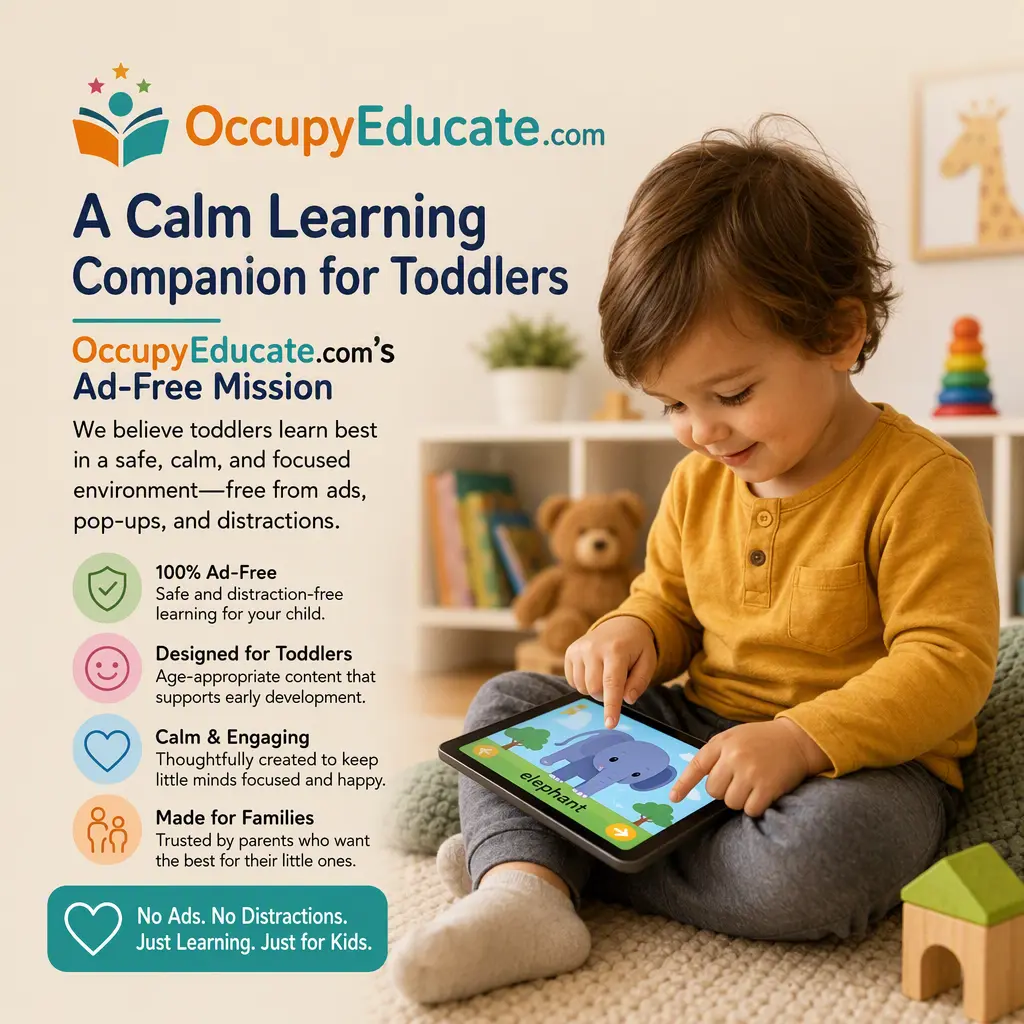
A Calm Learning Companion for Toddlers: OccupyEducate.com’s Ad-Free Mission
by Eddy The Emu

How Eddie the Educated Emu Helps Build a More Respectful Digital Beginning


For families with children ages 2-4, OccupyEducate.com offers a simple promise: learning time should feel safe, cheerful, and focused. Through Eddie the Educated Emu, BrightSHAPES creates offline edutainment without advertising, external links, or the constant interruptions that often shape children’s digital experiences. Parents can use this approach to make screen time a purposeful part of a young child’s day rather than another source of noise and negotiation.

Early learners need fewer competing demands

A toddler is still learning how to direct attention. When a screen includes flashing promotions, autoplaying videos, pop-ups, reward prompts, and invitations to leave the activity, the child has to process far more than the lesson itself. Even an adult can find that environment distracting; for a two-, three-, or four-year-old, it can turn a simple learning moment into a stream of competing cues.

OccupyEducate.com’s mission begins with removing those competing demands. Eddie the Educated Emu is designed as an educational activity, not a storefront or a channel for keeping children moving from one piece of content to another. The child’s attention can stay with the playful learning experience rather than being redirected toward a product, another app, or a video selected by an algorithm.

Ad-free design is a practical family choice

Choosing ad-free edutainment is not just about avoiding an inconvenience. It gives parents more control over what appears in front of their child. Advertising can be difficult for young children to recognize as persuasion, especially when it uses colourful characters, music, games, or familiar-looking buttons. At this age, a child may simply see it as part of the activity.

With an ad-free app, families do not have to explain why a tempting image is not available, close unexpected panels, or worry about a child tapping into unrelated material. That can make shared device time calmer in everyday situations such as:

  • a short learning session before breakfast;
  • a quiet activity while a parent prepares dinner;
  • a familiar routine during travel or waiting appointments;
  • a few minutes of playful practice with a caregiver nearby.

The value is in predictability. When parents open a learning app, they should know what kind of experience their child is entering.

Offline access supports dependable routines

BrightSHAPES also treats offline access as part of a child-friendly design. A learning activity should not disappear because a connection is weak, a family is travelling, or Wi-Fi is intentionally turned off. Offline use gives caregivers a dependable option when they want a contained activity without handing a child an open doorway to the wider internet.

This is especially useful for children ages 2-4 because routine matters. A child can come to recognize Eddie the Educated Emu as part of a consistent sequence: sit together, open the activity, explore, talk about what happened, and move on to the next part of the day. There is no need to search through recommendations or negotiate over what to watch next.

Edutainment should invite interaction beyond the screen

Fun and education work well together when the digital activity creates a reason to talk, point, repeat, remember, or try something in the real world. Eddie can become a familiar learning companion, while the adult remains the most important guide. A caregiver does not need to turn every moment into a formal lesson. Brief, natural questions are enough: “What did Eddie find?” “Can you show me that colour in this room?” “Which sound did you hear?”

Those small exchanges help children connect what they see with language and everyday experience. After a session, families can extend the play without a device by looking for shapes around the home, naming objects on a walk, sorting safe household items by colour, or retelling an Eddie-themed moment with toys. The app is a starting point for discovery, not a replacement for conversation, play, or hands-on exploration.

A calmer standard for children’s technology

OccupyEducate.com is built around the belief that children’s apps can be both engaging and respectful. Young learners do not need a louder interface, more commercial messages, or endless content to have a meaningful digital experience. They need an environment sized for their stage of development: clear, welcoming, limited in scope, and free from pressure to click, buy, or keep scrolling.

That standard also respects parents. Instead of asking families to constantly supervise a cluttered digital space, it gives them a more intentional tool for moments when they choose to use technology. Eddie the Educated Emu brings learning and lighthearted fun together while keeping the experience focused on the child.

Explore Eddie the Educated Emu as a calm addition to your child’s routine, then try one short shared session with notifications off and a simple follow-up question ready. A protected digital space works best when it supports the real-world connection happening beside it.

by Eddy The Emu

Offline Edutainment Gives Ages 2-4 Room to Explore at Their Own Pace


For children ages 2-4, a well-designed learning app should feel like a small, welcoming place to explore-not a stream of interruptions competing for attention. OccupyEducate.com’s mission is to offer ad-free, offline edutainment through BrightSHAPES and Eddie the Educated Emu, giving young children simple activities that support early learning while keeping the experience focused, predictable, and fun.

Young children learn through repetition and discovery

Toddlers and preschoolers do not need an endless catalog of content to learn. They learn by returning to familiar ideas: noticing that a circle is round, matching a color, hearing a word again, trying a puzzle one more time, and celebrating when a choice works. Repetition is not a lack of progress; it is often how early understanding takes root.

BrightSHAPES is built around this natural rhythm. Eddie the Educated Emu can introduce children to approachable learning moments without rushing them onward. A child may spend several minutes naming colors, tracing a familiar shape with a finger, or replaying a favorite activity. Those small choices help build confidence because the child is able to participate, predict what comes next, and try again without pressure.

  • Recognition: seeing colors, shapes, animals, and familiar objects repeatedly.
  • Language: hearing and connecting simple words with pictures and actions.
  • Problem-solving: making a choice, seeing the result, and adjusting on the next try.
  • Confidence: enjoying achievable challenges that make learning feel positive.

Offline design keeps the learning moment self-contained

An offline app has a practical advantage for families: once it is installed, the core experience does not depend on an internet connection. Learning can happen during a trip, in a waiting room, at a grandparent’s home, or during a quiet part of the day when Wi-Fi is unavailable or intentionally turned off.

More importantly, offline design supports a clear boundary. The app is there for its intended purpose: age-appropriate play and learning. It is not a doorway to suggested videos, web links, social feeds, or outside content that may be unsuitable for a young child. For ages 2-4, that simplicity matters. Adults can offer a device for a defined activity rather than opening a larger, less predictable digital environment.

This also makes transitions easier. A parent can say, “Let’s do one Eddie activity,” or “You can choose two shape games,” instead of negotiating with a platform designed to keep offering the next thing. Clear beginnings and endings help children gradually understand routines around screen time.

Ad-free means the child’s attention stays with the activity

Advertising is built to attract attention, often through movement, bright visuals, sound, urgency, or recognizable characters. Those tactics can be especially distracting for young children who are still developing the ability to focus and shift attention intentionally. In an educational setting, an ad does more than interrupt a game: it breaks the connection between the child and the skill they were practicing.

OccupyEducate.com’s ad-free approach keeps Eddie’s world consistent. There is no need for a child to distinguish an activity from a promotion, close an unexpected message, or ask an adult what a pop-up means. The focus remains on playful learning.

For caregivers, this creates a more straightforward experience as well. They can sit alongside their child and talk about what is happening on screen: “That is a triangle,” “Which color did you choose?” or “You found the matching pair.” Conversation turns digital play into a shared learning opportunity, rather than a moment repeatedly interrupted by content unrelated to the child’s development.

Edutainment works best when fun has a learning purpose

Fun and learning do not have to be opposites. For very young children, playful engagement is often the path to learning. A cheerful character, a satisfying sound, a simple challenge, and a warm response to success can encourage a child to keep exploring. The important question is whether the fun supports the activity’s purpose.

Eddie the Educated Emu is designed to make early concepts inviting. Rather than overwhelming a child with complex menus or fast-paced demands, the experience can keep the task understandable: notice, choose, match, listen, repeat. That structure respects the developmental stage of children who are beginning to build vocabulary, attention, memory, and independence.

  1. Choose a short, calm time for the activity, such as after breakfast or before a car ride.
  2. Begin with one familiar BrightSHAPES activity so the child knows what to expect.
  3. Use simple prompts: “Can you find blue?” or “What shape is that?”
  4. Let the child make choices and repeat activities without correcting every attempt.
  5. End with a clear transition to an offline activity, such as drawing shapes or finding colors around the room.

A safer digital start can still be joyful

Children ages 2-4 are curious, energetic, and eager to test what they can do. They deserve digital experiences that meet that curiosity with care. An app does not need constant novelty, persuasive prompts, or advertising to hold a young child’s interest. It can earn attention by being friendly, understandable, and genuinely enjoyable.

BrightSHAPES and Eddie the Educated Emu reflect OccupyEducate.com’s commitment to a more thoughtful kind of edutainment: offline, ad-free, and made for early learners. Explore the app with your child, choose a small daily learning routine, and let their next digital experience be one built for discovery rather than distraction.

by Eddy The Emu

From Digital Sanctuary to Daily Discovery: OccupyEducate.com’s Mission for Ages 2-4


OccupyEducate.com exists to give young children a gentler way to explore digital learning: one that is offline, ad-free, playful, and designed around the pace of early childhood. Beginning with Digital Sanctuary: Creating a Safe Haven in a Cluttered Digital World for Ages 2-4, the mission is not simply to remove distractions from a screen. It is to make room for focused discovery with Eddie the Educated Emu, then carry that sense of calm into a child’s everyday play, conversation, and growing independence.

A digital space should feel safe before it tries to feel exciting

Children between two and four are learning how the world works through repetition, movement, naming, sorting, listening, and trying again. They do not need a crowded digital environment competing for their attention. Pop-ups, autoplaying videos, outside links, sales prompts, and rapidly changing rewards can interrupt the very learning moment an educational activity is meant to support.

OccupyEducate.com takes a different starting point: protect the child’s attention. An offline app does not depend on an internet connection to deliver its core learning experience, and an ad-free experience does not turn a child’s playtime into an opportunity for third-party marketing. That creates a clearer boundary for families. When a child opens an activity with Eddie the Educated Emu, the purpose is learning and fun-not navigating a stream of commercial messages.

Educational play works best when children can stay with an idea

A toddler may want to hear the same sound, repeat the same matching activity, or return to a familiar character many times. Adults can sometimes mistake that repetition for a lack of progress, but repetition is how early learners build confidence. Each return can strengthen recognition, memory, vocabulary, and the understanding that their choices have meaningful results.

Calm edutainment gives children space to do this without being hurried toward the next thing. Rather than treating attention as something to capture for as long as possible, OccupyEducate.com’s approach treats attention as something worth respecting. A simple activity can invite a child to notice a shape, identify a color, connect a sound with an object, or practice following a small sequence. These are modest moments, but they support the foundations children use later for language, problem-solving, and self-directed learning.

  • Familiarity helps children feel capable enough to participate.
  • Repetition helps new words and concepts stick.
  • Simple choices let children practice agency without overwhelm.
  • Playful feedback encourages another try without pressure.

Offline access supports more intentional family routines

Offline learning is practical as well as protective. Families do not have to rely on Wi-Fi for a child to use an educational activity during travel, a waiting-room visit, a quiet afternoon, or time away from home. More importantly, offline access can help parents choose screen time on purpose rather than reaching for an endlessly connected feed whenever a child needs a distraction.

A short, predictable routine often works well for this age group. For example, a parent might sit with their child for ten minutes after breakfast, invite them to explore an activity with Eddie, and then continue the idea away from the device. If the activity includes colors, the family can look for colors around the kitchen. If it includes animals, the child can imitate animal sounds or find an animal in a book. The app becomes one part of learning, not the whole experience.

  1. Choose a brief time when your child is rested and receptive.
  2. Stay nearby, especially when introducing a new activity.
  3. Name what your child is noticing: “That is a yellow shape” or “You found the bird.”
  4. End before frustration or fatigue builds.
  5. Extend one idea through a book, toy, drawing, song, or conversation.

Eddie the Educated Emu brings warmth to early learning

Young children respond to familiar faces and dependable routines. Eddie the Educated Emu gives OccupyEducate.com a friendly guide for those early learning moments. A recurring character can help an activity feel welcoming rather than demanding, particularly for children who are still developing the language to explain what they want or how they feel.

The goal is not to replace a parent, caregiver, teacher, or real-world playmate. It is to offer a cheerful companion inside a carefully bounded learning experience. Eddie can help make educational ideas feel approachable while the adults in a child’s life remain the most important guides-asking questions, celebrating effort, and noticing what sparks curiosity.

A better children’s app is built around what families can trust

Trust is created through design choices that families can feel in everyday use. An ad-free, offline educational app should make its purpose easy to understand. Parents should not have to wonder whether an activity will lead a child toward unrelated content, collect their attention for marketing, or interrupt play with a purchase prompt. Children should be free to explore without being asked to manage decisions meant for adults.

That is the continuing mission of OccupyEducate.com: create safe, educational, fun digital experiences that honor childhood instead of competing with it. The digital sanctuary is the starting point. The larger aim is to help children build positive first experiences with learning technology-experiences that are calm, focused, and full of room to wonder.

Explore Eddie the Educated Emu with your child, begin with a short shared session, and notice which topics invite the most smiles, words, and questions. Those small discoveries can become meaningful learning moments far beyond the screen.